

Описание
Страна : Великобритания
Год : 1940
(проект)
Air-Britain Aeromilitaria 2-2005
The de Havilland That Never Was
The well-known Bruce Robertson serial-number book, and various other references, including Air-Britain's Impressments Log, list the serial number BH727 as being a 'DH Fighter Trainer' or 'DH Gipsy Trainer', a design which has remained something of a mystery.
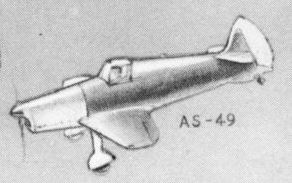
In fact this aircraft never existed, at least as an aircraft of de Havilland design. The serial number was requested in September 1940 by the Ministry of Aircraft Production Resident Technical Officer at Hatfield, for a prototype aircraft powered by a DH Gipsy Six engine and ordered under Contract B.156034/40, and the number BH727 was duly written in the relevant ledger and the details returned to the R.T.O. What had been overlooked was the fact that the design team from Airspeed (1934) Ltd, which was by then partly owned by de Havilland, had been evacuated to Hatfield from its location in Portsmouth, where it was very vulnerable to Luftwaffe attacks. Airspeed had received a contract (no. B.156034/40) to build a prototype single-engine, single-seat, trainer of wooden construction, to Specification T.24/40. This was to be powered by a DH Gipsy Six, and was intended to provide a mount for trainee fighter pilots to practice aerobatics and formation flying in an aircraft cheaper and perhaps rather more 'fighter-like' than their Master or Harvard advanced trainers. It has been suggested that the Gipsy Six engine was a supercharged version, developing close to 300 horsepower. At a slightly later date, the R.T.O., puzzled by the message giving a number for a 'de Havilland trainer' was on the phone again, asking for a serial for the Airspeed prototype, and the number BS750 was assigned. A few days later, early in October 1940, fifty more numbers (BS827-BS848 and BS863-BS890) were assigned to production aircraft of the same type, this time under Contracts/Aircraft/67/C.23(b).
Meanwhile, design was proceeding at Hatfield and a mockup had been made. All was going well until 3rd November 1940, when a lone Luftwaffe Junkers Ju 88 sought out Hatfield and dropped bombs that damaged the buildings where the Airspeed staff was working, destroying the mockup and many of the drawings and other design data. The Ju 88 was shot down, but the Airspeed AS.49 never took to the air, the whole project being cancelled. Very soon there were plenty of early Mark Hurricanes and Spitfires available, replaced by newer aircraft, to fill the ranks of the Operational Training Units. The Airspeed and de Havilland design teams moved out of Hatfield to Salisbury Hall at London Colney, where they worked on the design and construction of the Airspeed Horsa and de Havilland Mosquito prototypes, which were built at this dispersed site. The first Horsa, DG597, was taken to Heathrow for its first flight on 12th September 1941, while the Mosquito, E-0234 (later W4050) flew to Hatfield from a strip at Salisbury Hall on 25th November 1940.
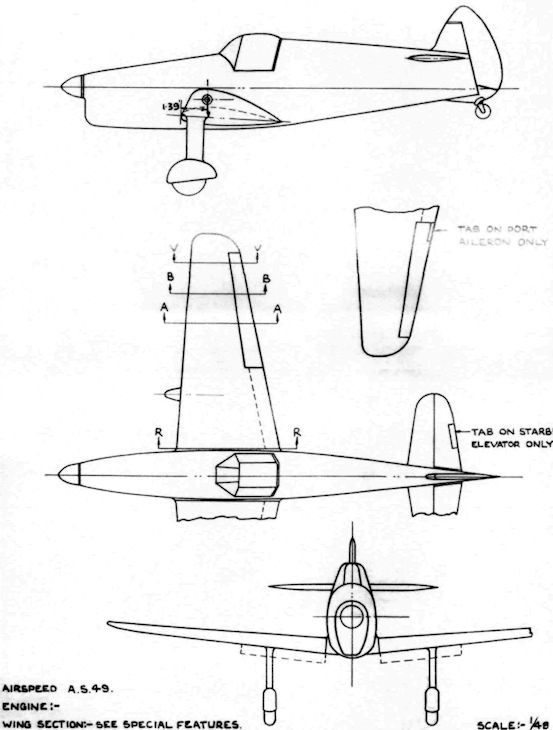
An Air Ministry drawing of the projected AS.49, probably used for checking design calculations at Farnborough, survives and is reproduced below.
Phil Butler
- Air-Britain Aeromilitaria 2-2005
Фотографии
- Фотографии